

















Bitcoin has pushed firmly above the $70,000 mark, trading around $71,800 at the time of writing. The asset has gained about 7% in the past 24 hours and is up more than 5.5% over the week, continuing its upward move despite geopolitical concerns and rising energy prices.
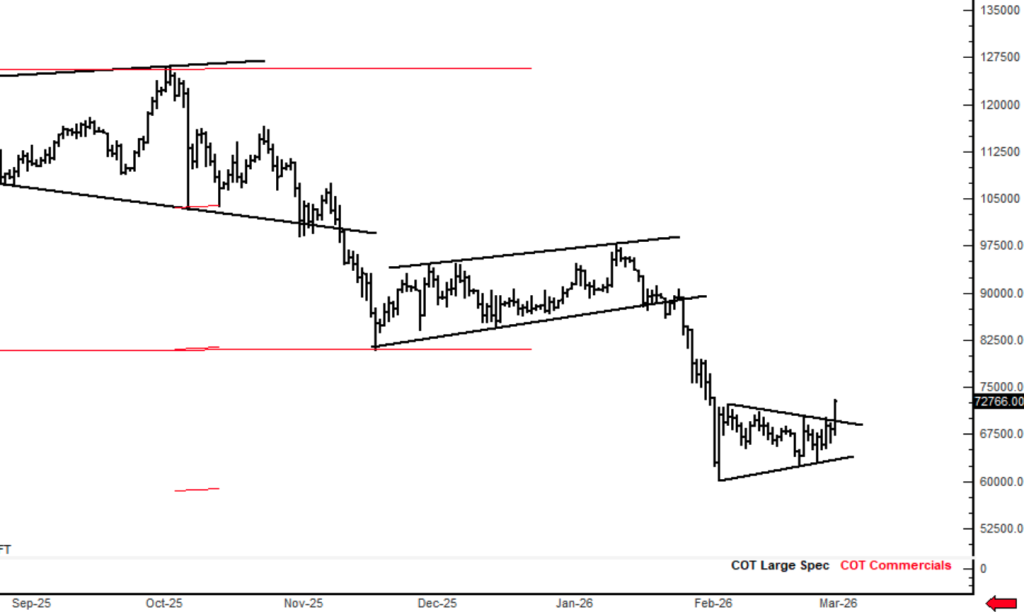
The recent price action has caught the attention of veteran trader Peter Brandt, who suggested that the market may be entering a new phase after months of weakness following the October peak.
Brandt Signals Possible Shift in Bitcoin Trend
For much of the past several months, Brandt maintained a cautious stance after Bitcoin reached its late-October high. He previously outlined the possibility of a longer market cycle bottom forming around October 2026.
However, his latest analysis hints that the short-term outlook may be changing. Discussing the current chart structure, Brandt wrote:
“I view this as potentially the significant change of price behavior since the top in Oct.”
His chart shows that after peaking near $127,500, Bitcoin entered a clear downward structure. The price slipped under $105,000 and later lost support near $82,500, accelerating the decline toward the $60K–$65K range.
A brief rebound failed to hold, sending the market to another low earlier this year. Now, the price is stabilizing near $73K within a short-term upward channel. Key resistance sits between $75,000 and $78,000, while support levels are seen near $65,000 and $60,000.
Analysts See Signs of a Bottom
Brandt’s comments sparked reactions from other market watchers. Investor Tom Lee noted that the current setup could mark a turning point for Bitcoin, suggesting the market may be building a base for a broader recovery.
Other analysts point to rising demand on major exchanges. Data indicates that buying activity from U.S. traders has strengthened, pushing exchange premiums to their highest levels since late 2025.
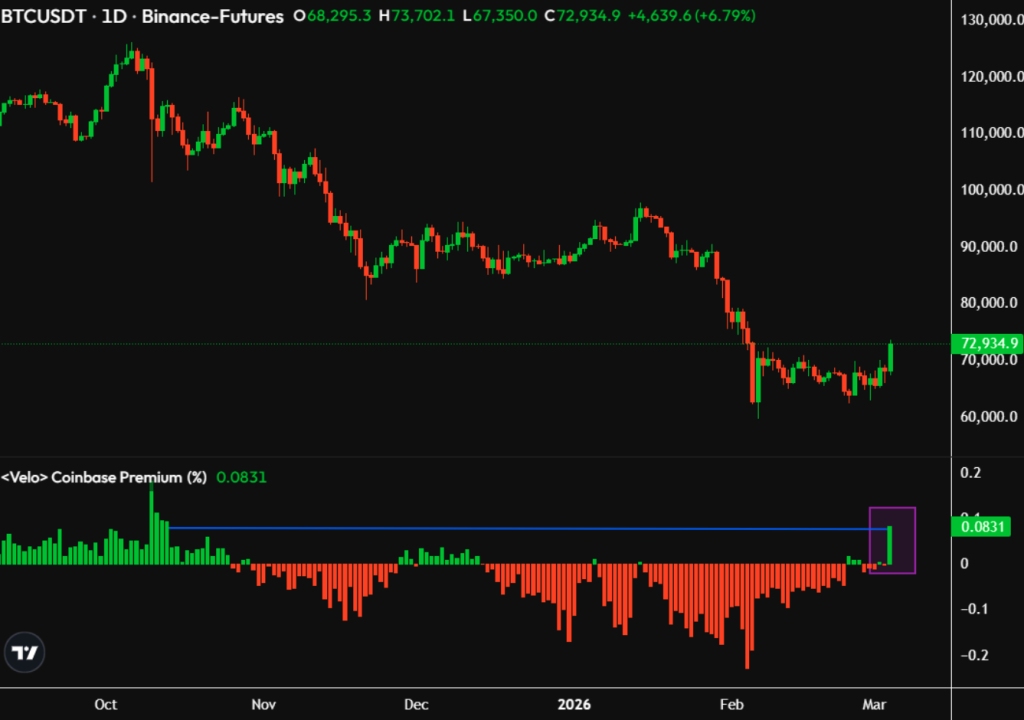
At the same time, Bitcoin recently struggled to break through the $71,500 area, facing several rejections in recent weeks. Still, some analysts believe supply pressure may be easing.
One factor supporting that view is strong ETF demand. Around $225 million flowed into Bitcoin ETFs in a single day, followed by another $458 million the day before, nearly $700 million in just 48 hours. Continued inflows could push total ETF flows for the year back into positive territory.
Macro Risks and Policy Developments
While momentum has improved, broader economic developments continue to influence the outlook for Bitcoin.
U.S. Treasury Secretary Scott Bessent recently indicated that a proposed 15% global tariff plan backed by Donald Trump could begin rolling out this week. Such measures could introduce volatility across financial markets.
On the regulatory side, lawmakers are also debating new crypto market structure legislation known as the CLARITY Act. Trump has urged Congress to move quickly on the proposal, arguing that clear rules are necessary for the United States to remain competitive in the digital asset space.
If approved, the legislation could offer greater regulatory certainty for institutional investors entering the sector beyond major assets like Bitcoin, Ethereum, and Solana.
With rising ETF demand, signs of seller fatigue, and ongoing regulatory discussions, the current environment may differ from earlier failed breakout attempts, leaving traders closely watching whether Bitcoin can extend its latest rally.
Disclaimer: This content does not constitute trading or investment recommendations. It’s essential to conduct your own research before purchasing any cryptocurrency or investing in any services.