
















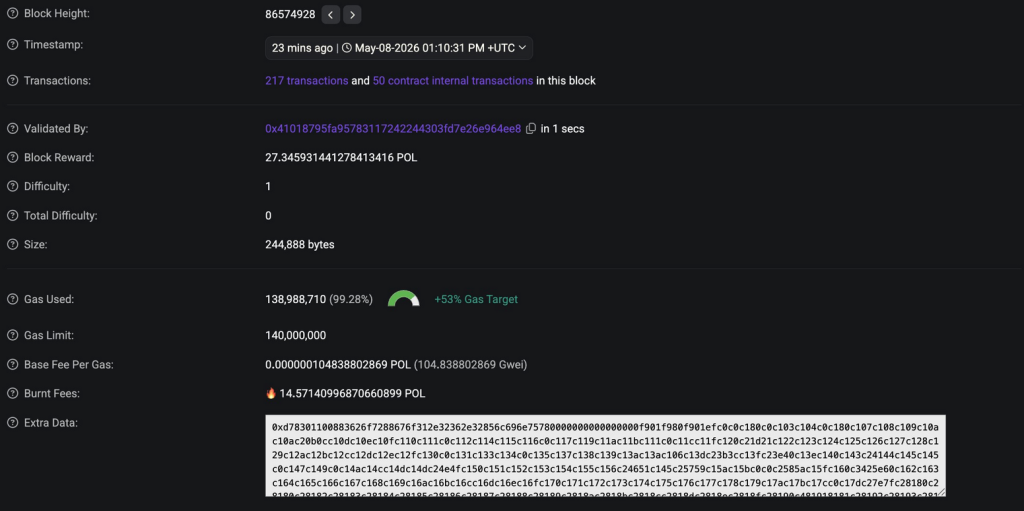
Polygon has rolled out a major network upgrade aimed at improving scalability and handling larger volumes of on-chain activity. The update raises the network’s gas limit to 140 million, pushing Polygon’s throughput beyond 3,800 transactions per second (TPS).
The move is part of Polygon’s broader push to position itself as a leading infrastructure layer for blockchain payments, DeFi activity, and real-world financial applications.
Polygon Targets Higher Transaction Demand
By increasing the gas limit, Polygon can now process more transactions and smart contract activity within each block. That added capacity is expected to support growing demand from payment platforms, stablecoin transfers, tokenized assets, and decentralized applications.
Polygon highlighted on X that the upgrade is designed to prepare the network for larger-scale on-chain payments and wider blockchain adoption.
Scalability continues to be one of the biggest priorities across the crypto industry as networks compete to offer faster settlement speeds and lower fees. With stablecoins and tokenized finance gaining traction globally, infrastructure capable of handling massive transaction volumes is becoming increasingly important.
Competition Between Blockchain Networks Intensifies
The latest Polygon upgrade arrives as Layer 1 and Layer 2 ecosystems race to improve performance and attract developers, institutions, and payment providers.
Over the past few years, blockchain throughput has rapidly evolved from a few hundred TPS to several thousand. Networks are now preparing for future demand tied to payments, gaming, AI-driven applications, and institutional finance.
Supporters of Polygon believe upgrades like this are necessary if blockchain infrastructure is expected to compete with traditional financial systems that already process huge transaction volumes daily.
On-Chain Payments Continue Growing
Blockchain-based payments remain one of the fastest-growing sectors in crypto. Stablecoins are increasingly being used for remittances, settlements, payroll services, treasury management, and cross-border transactions.
As adoption rises, networks capable of offering reliable, low-cost, high-speed transactions are likely to play a larger role in the future financial system.
Polygon’s latest upgrade reinforces its focus on scalable payment infrastructure rather than simply competing as another smart contract platform.
Polygon Pushes Toward Mass Adoption
Crossing the 3,800 TPS mark represents another step in Polygon’s effort to support large-scale financial activity without network congestion or excessive transaction fees.
As the crypto industry shifts its attention toward real-world utility and scalable infrastructure, performance upgrades like this could become a major factor in determining which blockchain networks lead the next phase of adoption.
Disclaimer: This content does not constitute trading or investment recommendations. It’s essential to conduct your own research before purchasing any cryptocurrency or investing in any services.